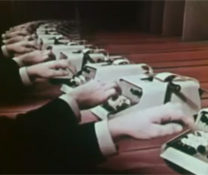
Ball-point pen on paper illustrations by Shohei Otomo…
It’s been a while since I last looked at this stuff and made (then promptly lost) the mental note about posting it here, so big thanks to the good people over at the Nice Produce blog for posting it there and jogging my memory.
You can see more of Shohei’s work on his site… here.
Interesting stuff to look at on his blog too, probably a lot more interesting if you can read Japanese though.
The second chapter of the Element documentary is finally out, covering the period I’ve been most excited about seeing again. The first chapter focused largely on Johnny Schillereff and his personal background but this one moves on to the original Underworld Element initiated with Andy Howell.
“The first incarnation of Element came in the form of a small collaborative, East Coast company called Underworld Element. Most often referred to as Underworld, the company was inspired by the hip-hop movement and used a mixture of urban styles and reflected a raw and controversial vibe.
Soon after its inception, Underworld was plagued with many challenges, and the business began to collapse. Its original crew had all moved on, and Johnny was left with two choices: either turn the struggling brand around, or abandon Underworld altogether and start something entirely new.”
You can watch the above on the Element site at a variety of resolutions here.
If you’re into the documentary then the first Element video ‘Fine Artists’ (above) is a good follow up move.
After much procrastination, I’m pleased to finally be posting the first installment of our mix series, Slide. Mixtapes have been an obsession of mine for about as long as I can remember. I have this ongoing fascination with the way we interpret various media… how no two individuals have the exact same take on a particular project and how these unique relationships influence our sense of involvement.
With a well considered mixtape, tracks can be placed in certain contexts and you often end up hearing something familiar in a new light. There’s a lot to be gleaned about the person putting the mix together too, the variety of tracks and moods and the type of transitions between them all say something about that individuals relationship with the ideas they’re using.
So the concept is simple, I’ve got together a pile of mixes from friends and associates and with their permission I’ll be posting them at intervals here on the blog via soundcloud. Over time we should rack up an interesting archive from the past present and future. Enough introductory rambling now, on to the first installment…
I’m starting the series with a mix of my own from 2003 which may seem a little self indulgent though there is a specific reason for it too. Multilink wasn’t originally conceived as a magazine, it basically started life as a desire to get involved with creative people and projects of as wide a variety as possible. We stumbled into the idea of a pdf mag after Steve showed me Bloodwars and it seemed like something that between us we could get moving pretty quickly, so that’s what we did. With no experience of any conventional magazine editorial process, my plan was to approach the first issue as a mixtape only made with people and projects as opposed to 12″s and LPs and that’s basically what I’ve stuck with for all subsequent issues since.
The significance of starting our series with the Disengage mix is that it was planned and recorded during the same period Steve and I put together issue #01 of multilink. So as different as the end formats may be, I’ve always felt they shared a similar process in regards to selection and assembly.
I plan to avoid describing the content of each mix, opting instead for a little background info each time. However, if you do require serving suggestions then this one is probably well suited to long journeys or extended sessions of lazy leisure.
Download the mp3 via the arrow on the Soundcloud player. Larger front/back artwork and track listing can be downloaded here.
Following my previous post about the High Tech Soul documentary, I keep finding myself sitting up late at the computer digging up various images and accounts regarding the degeneration of Detroit. One of the many stories that stood out was that of the Michigan Central Station, which in turn lead me to the photography of Kevin Bauman…
“When built in 1913, the Michigan Central Station was the world’s largest train station. The station was built fairly far from the downtown, with the hopes that it would anchor further development in the area. The station was used heavily through World War II, though the Great Depression slowed development in the city. Michigan Central Station saw declining usage shortly after. Unfortunately the station was never even filled to capacity with several upper floors never being used.
The station finally closed for good in 1988. It has stood empty ever since, and after years of neglect and deterioration, the Detroit City Council has voted to demolish the historic building, and bill the owner, Matty Moroun, for the costs.”
The above images and text where taken from a project page of Kevins on Behance Network, click here to view the entire set. Also via his Behance profile you will find a set of various night scenes from metro Detroit and his 100 Abandoned Houses project.
I’ve just been revisiting the DVD of this 2006 documentary, available to watch online via youtube.
This is to some extent a compressed interpretation of Dan Sicko’s book, Techno Rebels which comes highly recommend if you’re into the subject matter (a revised edition of which is apparently in development although the last update on that appears to have been in April).
Techno and it’s early roots in Detroit are the focus here. Unlike Sicko’s book which I remember as relatively reserved in it’s accounts, this initially suffers a little from the barrage of overwhelming ego’s on parade. There’s some pretty bold and potentially quite questionable statements being thrown around regarding certain individuals views on what techno is and who’s ultimately responsible for it, the kind of conclusions I would prefer to draw later for myself as opposed to being fed as an introduction. Don’t let this put you off though as it’s by no means a deal breaker and easily explained as an inevitable consequence of the level of passion involved.
It’s an informative story on a number of levels. A big highlight for me being the inclusion of academic Jerry Herron with his accounts of the city’s social and economic history of the last 50 years and it’s role in shaping the circumstances and environment in which all this could manifest.
If you’re not a fan of techno I would still suggest you give this a go. You may be pleasantly surprised and if it leads you onto the book, there’s a whole other level of in-depth and worthwhile material to be explored there in regards to creative drive and progression in general.
From Plexifilm…
“HIGH TECH SOUL is the first documentary to tackle the deep roots of techno music alongside the cultural history of Detroit, its birthplace. From the race riots of 1967 to the underground party scene of the late 1980s, Detroit’s economic downturn didn’t stop the invention of a new kind of music that brought international attention to its producers and their hometown.
Featuring in-depth interviews with many of the world’s best exponents of the artform, High Tech Soul focuses on the creators of the genre — Juan Atkins, Derrick May, and Kevin Saunderson — and looks at the relationships and personal struggles behind the music. Artists like Richie Hawtin, Jeff Mills, Carl Craig, Eddie Fowlkes and a host of others explain why techno, with its abrasive tones and resonating basslines, could not have come from anywhere but Detroit.”